Well, it’s fall. Oh, alright, technically not until 21 September, but leaves are starting to turn, die and fall off the trees (or turn, fall off the trees and die). Even here in Seattle, where it’s freaking 85 degrees and we’ve had only one day of rain since July 18th.
Those of you in the parade route of tropical storms are experiencing mid-monsoon season, from what I can gather. Hurricanes can show up through the end of, what, November? October? Nope, not gonna look it up. Sorry. But if you’re stuck at home, you might as well knit stockings.
I found these late summer stocking and sock patterns from the Australian Women’s Weekly dated 24 February 1965. (No, I’m not an idiot - their seasons are opposite of ours). The stocking patterns on page 18 are for some wonderfully lacy patterns. I haven’t knitted them - c’mon, if I waited to knit them before posting the patterns, we’d all be living in Keynes’ long run (i.e. dead). So I thought I’d post the patterns along with some other fun (!?!) stuff from that issue of AWW.
The cover shows a nice selection of stockings - none of them are actually included in the patterns to knit, but those brownish-stockings in the diamond pattern would be super-easy to make on ones own. All you need is a diamond pattern & you can make it garter or purl fabric. (Click to embiggen.)
More stocking/sock eye candy from this issue, and another diamond pattern that I like very much (Click to embiggen):
Now, I know everyone is anticipating the stocking patterns - but hold on. There’s some wonderful crap I found in this issue that I’m going to share. For example, there were labels and bookmarks for kids to put on their notebooks. Check out the first one - it has a proto lolcat photo. That cat looks like one surly drunk! The others pale in comparison to “Party Cat”. (I assume everyone understands to click on the photos to see a larger version - and you really do want to click on the next one.)
Here are some photos of the new ‘military look’ coming into fashion that year. I love the pointy plaid shoes, even though I’d never wear them. All that plaid... I don’t see anything exceptionally military by my definition, but I have no idea how the Australian military dressed in the early 1960s.
And some recipes - I love reading through old recipes. Sometimes they're almost Lovecraftian in the level of horror they can induce. This issue had a bunch of gingerbread recipes, some of them disturbing, and we all know I love to share disturbing.
The first page has some basic, decent-sounding recipes. The brandied-honey recipe sounds like a good idea and a nice thing for a chilly night.
The second has what I consider questionable entries. The coffee spice one, for example - coffee, chocolate and ginger... Or recipes that call for treacle (the Scotch gingerbread). And a pineapple upside down gingerbread - I don’t like anything pineapple upside down. Ugh.
I’m not sure about the lemon cheese pie, either - do people use gelatin in that way anymore? It’s made of hooves, you know.
Below is an interesting tale of Olde New Yorke, which sounded, well, rather like Olde New Yorke. No artisanal expensive crap in this story of the East Village. I liked the photos, too.
I love the description of the store on 14th; I always try to find stores like that. Big, sexy, rich cities like Seattle and Manhattan have done their best to eliminate those kind of businesses. Too bad - amazing treasures were to be had in that type of place.
Are you bored yet? Good. Here are the stocking patterns:
And finally, I want to make a product with the name “Dominex”. That’s a great name, whether it’s for pudding or personal ads (or both, I guess).
Seems wasted on a coat manufacturer, particularly since there are no leather straps and buckles and such.
Oh yeah, the Mary Elizabeth Braddon novel I was going to post is on Google now (in my defense, it wasn't 3 years ago when I last checked). So you can click on The Phantom Fortune if you wish to read it (this will take you to vol. 1 on Google books).
Showing posts with label patterns. Show all posts
Saturday, September 10, 2011
Blockage, plus inane ramblings
I finally got some stuff blocked - my friend Trixie asked me to block a shawl for her, so while I was in blocking mode I did a couple of other things:
Finally, the Hemlock Ring blanket completed in January 2009:
And I blocked December Wind by Renee Leverington (purple confuses my camera - I don't know why - so the photos are extra crappy):
My mother liked this one even before it was blocked, so I gave it to her for her birthday. The yarn was from Susan at the Spinning Bunny, and was lovely to work with. Note that this is the first time my mother has ever liked anything I've knitted.
.
And then I blocked Dover Castle, which I'd knitted up in the lightweight version of Berroco's Ultra Alpace - that stuff is also really sweet to work with:
Meh. I have no idea what was confusing my camera. They've been tearing down the building just outside my kitchen window; when I take pix of the Leviathan that's eating the building, they turn out just fucking fine:
So perhaps I should just stick with photos of heavy equipment. Or perhaps I need to display my FOs on heavy equipment. I was going to make some snide remark about "forget those tastefully displayed items in beautiful settings", but since I don't put fuck-all effort into photographing my work such sarcasm would simply make folks spit out their coffee. And I don't want that.
I got an email yesterday, along with my other classmates, offering us temporary positions again with the CIA - since I can't live on the $800/month I'm currently getting on UI, I will be working again starting the 16th of this month. So I need to get a few things posted in the next few days. I mean, I've only had 5-1/2 months to do anything.
No surprise, I spent my last Friday night of freedom in a knitting workshop with Franklin Habit. Honestly, I'd recommend taking anything from him, even if it's a workshop on making mud pies. Smart, funny, and passionate about teh knitting. The class I took was Knitting from Antique Patterns, or some such title (you really expect me to move from my seat and look up the exact title? Really? Well, I'm practicing immobility in preparation of returning to work, so there). There was a woman who brought her grandmother's notebook of knitting patterns - I wish we'd had an hour to look through those babies, although perhaps my drooling on them wouldn't have been the best thing. Oh well, I'll satisfy myself with the 1884 Sampler Books (see link on left side bar) and Nancie Wiseman's "Lace in the Attic". In fact, I've a couple of wrister experiments in the wings using several of the 1884 Sampler Book edgings. Someday they'll be completed and posted... someday....
Finally, the Hemlock Ring blanket completed in January 2009:
And I blocked December Wind by Renee Leverington (purple confuses my camera - I don't know why - so the photos are extra crappy):
.
And then I blocked Dover Castle, which I'd knitted up in the lightweight version of Berroco's Ultra Alpace - that stuff is also really sweet to work with:
Meh. I have no idea what was confusing my camera. They've been tearing down the building just outside my kitchen window; when I take pix of the Leviathan that's eating the building, they turn out just fucking fine:
So perhaps I should just stick with photos of heavy equipment. Or perhaps I need to display my FOs on heavy equipment. I was going to make some snide remark about "forget those tastefully displayed items in beautiful settings", but since I don't put fuck-all effort into photographing my work such sarcasm would simply make folks spit out their coffee. And I don't want that.
I got an email yesterday, along with my other classmates, offering us temporary positions again with the CIA - since I can't live on the $800/month I'm currently getting on UI, I will be working again starting the 16th of this month. So I need to get a few things posted in the next few days. I mean, I've only had 5-1/2 months to do anything.
No surprise, I spent my last Friday night of freedom in a knitting workshop with Franklin Habit. Honestly, I'd recommend taking anything from him, even if it's a workshop on making mud pies. Smart, funny, and passionate about teh knitting. The class I took was Knitting from Antique Patterns, or some such title (you really expect me to move from my seat and look up the exact title? Really? Well, I'm practicing immobility in preparation of returning to work, so there). There was a woman who brought her grandmother's notebook of knitting patterns - I wish we'd had an hour to look through those babies, although perhaps my drooling on them wouldn't have been the best thing. Oh well, I'll satisfy myself with the 1884 Sampler Books (see link on left side bar) and Nancie Wiseman's "Lace in the Attic". In fact, I've a couple of wrister experiments in the wings using several of the 1884 Sampler Book edgings. Someday they'll be completed and posted... someday....
Friday, June 17, 2011
It's only been 10 months
Finally back on the interwebz, as they used to say somewhere at some point in time.
Apologies if you experience weirdness upon visiting the blog. I've been tinkering with a pre-designed template (because I'm too lazy to master html), but it came with some crap that I didn't want, and I haven't been able to disable it all yet. And I'm not entirely pleased with what I'm getting, but hopefully this is at least legible. Let us all pray to our various deities, or wish really hard (for those who eschew the gods) that I'll find it in me to fix it for once and for all.
'The like' consists of a novel written by Mrs Mary Elizabeth Braddon, author of "Lady Audley's Secret", one of my favorite Victorian novels, a rather lurid tale. Elizabeth Klett does a wonderful reading of it that you can access at Librivox. I know that some of the Librivox recordings are painful - in fact, some qualify as torture, but I assure you, Ms Klett does a fine job of reading this tale. It was a wonderful thing to listen to during a cold winter, knitting up shawls.
Good grief, have I digressed and in a most meandering fashion! The point is, I found an 1883 novel of Mrs Braddon's in one of the Australian newspapers, so I'll be posting it over the next few weeks. I haven't read it - it could be a real dog. If so, I'll be sharing the pain with y'all fine readers.
I have also knitted up a couple of lace patterns found in various fine down-under fish wrappers. One is from the Launceston Examiner dated 28 November 1893; it's from a ladies' column. It looks like shark fins more than anything else. Yes, yes, a variation on sawtooth edgings... but if you hold it with the points pointing upward, it looks like a line of baby shark fins.
To continue in this way, do not knit a 'Row 14' but instead start again with Row 2. The instructions said to repeat from Row 2, but didn't include that last bit, so my first time around proved quite entertaining. The slipped stitches at the beginning of each row do not reduce the stretchiness of the edging - indeed, I cannot emphasize enough exactly how freaking stretchy this is. I chose to knit it in garter stitch - many olde timey edgings were, and of course that helped with the stretchy. Sample was knitted on US 6/4 mm needles with some fingering weight yarn. I blocked the bejeezus out of this edging.
The next is from the North Australian Supplement dated Saturday, 28 April 1888, and was found in the "Household" section.
Again, I worked this in garter stitch for the sample. The pattern calls for 'knit plain', which I generally take to mean stockinette, but again, since I've seen many older edgings worked in garter, I decided to start with that. Sample is worked in Knit-Cro-Sheen (probably - unmarked thread, but the same weight) on US 3/3.25 mm needles for that extra-lace look. Actually because that was the first size that came to hand....
I thought this was an interesting lace - I've seen lots with big holes, but the thread/needle combination created something fairly impressive. And I have no idea which is the 'top' and 'bottom' edge of the lace; no illustration was provided, so I chose the side with the most shape as the 'bottom' edge. I didn't try to get a straight edge on both sides; I suppose one could use it as an insertion but since the pattern is different on the two edges I chose not to try that experiment.
I've also pulled some recipes from the Launceston Examiner, and hints for a woman about to be engaged from the North Australian Supplement in case someone out there is seeking personal advice from 1888.
The advice for engaged women (jpeg on the right, bottom row) is rather long & fairly uninteresting unless you have a mind sufficiently dirty to render the phrase "with a servant behind" mildly entertaining.
Jpegs are included below in case you think I've made a typo (or in case I have made a typo).
Apologies if you experience weirdness upon visiting the blog. I've been tinkering with a pre-designed template (because I'm too lazy to master html), but it came with some crap that I didn't want, and I haven't been able to disable it all yet. And I'm not entirely pleased with what I'm getting, but hopefully this is at least legible. Let us all pray to our various deities, or wish really hard (for those who eschew the gods) that I'll find it in me to fix it for once and for all.
The main reason for the long silence was that I was employed from September 2010 until April 2011. The job was a soul-consuming madness-inducing tribulation –but nonetheless I was working my ass off, in addition to the hellish commute (most of that time the round trip from the job was 2 hrs 40 minutes), simply trying to stay employed. All for naught, of course – everyone they hired in September they laid off just over six months later.
It’s taken me a few weeks to get things sorted, and to get in the knitting groove again. So I’ll have some things to post over the next while -- I've had more time to look through Australian newspapers for lots of old crap, er vintage & Victorian knitting patterns and the like, as well as some 1930s stuff (‘cause that’s when the best designs were done if you ask me, or even if you didn’t).
'The like' consists of a novel written by Mrs Mary Elizabeth Braddon, author of "Lady Audley's Secret", one of my favorite Victorian novels, a rather lurid tale. Elizabeth Klett does a wonderful reading of it that you can access at Librivox. I know that some of the Librivox recordings are painful - in fact, some qualify as torture, but I assure you, Ms Klett does a fine job of reading this tale. It was a wonderful thing to listen to during a cold winter, knitting up shawls.
Good grief, have I digressed and in a most meandering fashion! The point is, I found an 1883 novel of Mrs Braddon's in one of the Australian newspapers, so I'll be posting it over the next few weeks. I haven't read it - it could be a real dog. If so, I'll be sharing the pain with y'all fine readers.
I have also knitted up a couple of lace patterns found in various fine down-under fish wrappers. One is from the Launceston Examiner dated 28 November 1893; it's from a ladies' column. It looks like shark fins more than anything else. Yes, yes, a variation on sawtooth edgings... but if you hold it with the points pointing upward, it looks like a line of baby shark fins.
A Young Reader: The following is an easy edging suitable for Shetland or other wool shawls. By Butterfly.
Cast on 3 sts.
Row 1: Sl 1, k 2.
Row 2 & every even row: Sl 1, knit across.
Row 3: Sl 1, yo, k2.
Row 5: Sl 1, yo, k3.
Row 7: Sl 1, yo, k4.
Row 9: Sl 1, yo, k5
Row 11: Sl 1, yo, k6
Row 13: Cast off 5, k2.
To continue in this way, do not knit a 'Row 14' but instead start again with Row 2. The instructions said to repeat from Row 2, but didn't include that last bit, so my first time around proved quite entertaining. The slipped stitches at the beginning of each row do not reduce the stretchiness of the edging - indeed, I cannot emphasize enough exactly how freaking stretchy this is. I chose to knit it in garter stitch - many olde timey edgings were, and of course that helped with the stretchy. Sample was knitted on US 6/4 mm needles with some fingering weight yarn. I blocked the bejeezus out of this edging.
The next is from the North Australian Supplement dated Saturday, 28 April 1888, and was found in the "Household" section.
Imitation English Thread Lace
Cast on 9 sts.
Row 1: K2, yo, k3, yo, k2tog, k2.
Row 2: Knit plain.
Row 3: K2, yo, k5, yo, k2tog, k1.
Row 4: Knit plain.
Row 5: K2, yo, k1, k2tog, yo x 3, sl 1, k2tog, psso, k1, yo, k2tog.
Row 6: K4, k1-p1-k1 in the 3 yos, knit plain the remaining sts.
Row 7: K1 ,k2tog, yo, k2tog, k3, k2tog, yo, k2.
Row 8: Knit plain.
Row 9: K1, k2tog, yo, k2tog, k1, i2tog, yo, k3.
Row 10: Knit plain.
Row 11: K1, k2tog, yo, sl 1, k2tog, psso, yo, k4.
Row 12: Knit plain.
Again, I worked this in garter stitch for the sample. The pattern calls for 'knit plain', which I generally take to mean stockinette, but again, since I've seen many older edgings worked in garter, I decided to start with that. Sample is worked in Knit-Cro-Sheen (probably - unmarked thread, but the same weight) on US 3/3.25 mm needles for that extra-lace look. Actually because that was the first size that came to hand....
I thought this was an interesting lace - I've seen lots with big holes, but the thread/needle combination created something fairly impressive. And I have no idea which is the 'top' and 'bottom' edge of the lace; no illustration was provided, so I chose the side with the most shape as the 'bottom' edge. I didn't try to get a straight edge on both sides; I suppose one could use it as an insertion but since the pattern is different on the two edges I chose not to try that experiment.
I've also pulled some recipes from the Launceston Examiner, and hints for a woman about to be engaged from the North Australian Supplement in case someone out there is seeking personal advice from 1888.
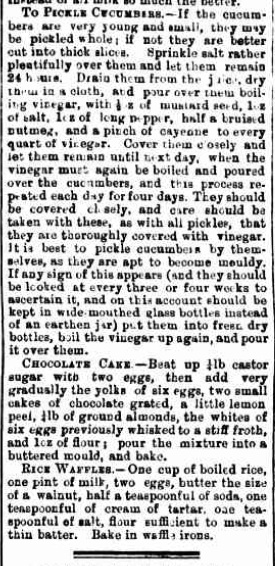
Woman's World (by Butterfly.) Pudding Recipe.
I am told that the pudding you require is an Austrian (...); its name is Weichzel(?) strudel. The paste is made with egg and flour, and rolled out to the thinness of paper on a clean linen cloth. Have ready cherries (stoned), and spread them on the paste; sprinkle with fine sugar, nutmeg, and a little cinnamon. Then roll as for a "roley-poley" until the roll is between 2-1/2 in and 3 in thick; bend or twist it into a coil; place on a baking-tin well buttered, and put a little butter on the roll. This is often made with apples, sliced and cut into small pieces, when cherries are not in season. {NB - the type was difficult to read at the beginning of the recipe, hence the parentheses.}I suspect one could simply go to the grocery store and purchase some filo dough to use instead of experimenting with pastry recipes, but I haven't tried this one, so experiment at your own risk, folks!
Rice Waffles. - One cup of boiled rice, one pint milk, two eggs, butter the size of a walnut, half a teaspoonful of soda, one teaspoonful of cream of tartar, one teaspoonful of salt, flour, sufficient to make a thin batter. Bake in waffle irons.
Chocolate Cake. - Beat up 1/4 lb castor sugar with two eggs, then add very gradually the yolks of six eggs, two small cakes of chocolate grated, a little lemon peel, 1/4 lb of ground almonds, the whites of six eggs previously whisked to a stiff froth and 1 oz of flour; pour the mixture into a buttered mould, and bake.I haven't cooked up these either - the chocolate cake recipe certainly isn't the typical modern chocolate cake; I'm certainly curious to make that one. As for the rice waffles - well, let me know how that one turns out, okay?
The advice for engaged women (jpeg on the right, bottom row) is rather long & fairly uninteresting unless you have a mind sufficiently dirty to render the phrase "with a servant behind" mildly entertaining.
Jpegs are included below in case you think I've made a typo (or in case I have made a typo).
Friday, August 27, 2010
I'll Bet This Is Highly Effective Birth Control
KNITTED RUBBER, IN COTTON.
Includes instructions if a longer rubber is needed.
(Yes, I realize this is extremely sophomoric humor.)
This makes an excellent substitute for a sponge for children, and can be so easily kept nice and free from grease and so quickly renewed that it will be a favourite manner of knitting for the nursery.
Materials : Knitting cotton No. 6 (white only), two knitting needles, No. 10.
Cast on 78 stitches and knit 4 rows of plain knitting.
—1st row of pattern. Knit 3, *, make 1 by putting the thread in front, slip 1, knit 2 together, repeat from * 23 time* more, knit 3
—2nd row. Knit plain.
—3rd row. Knit 3, *, knit 2 together, slip 1, make 1, repeat from * 23 times more, knit 3.
—4th row. Knit plain.
Repeat these 4 rows 24 times (more if requiring a longer rubber), knit 4 rows (NB - I believe this refers to a garter st border); and to form a loop for hanging up the rubber cast off 33 stitches, knit 8, turn, cast off 4, and on the remaining 4 work 16 rows, place the 4 stitches to the first 4 stitches of the remaining 37, and cast off together, cast off the remainder of the row.
From The Queenslander, January 8, 1906
Includes instructions if a longer rubber is needed.
(Yes, I realize this is extremely sophomoric humor.)
This makes an excellent substitute for a sponge for children, and can be so easily kept nice and free from grease and so quickly renewed that it will be a favourite manner of knitting for the nursery.
Materials : Knitting cotton No. 6 (white only), two knitting needles, No. 10.
Cast on 78 stitches and knit 4 rows of plain knitting.
—1st row of pattern. Knit 3, *, make 1 by putting the thread in front, slip 1, knit 2 together, repeat from * 23 time* more, knit 3
—2nd row. Knit plain.
—3rd row. Knit 3, *, knit 2 together, slip 1, make 1, repeat from * 23 times more, knit 3.
—4th row. Knit plain.
Repeat these 4 rows 24 times (more if requiring a longer rubber), knit 4 rows (NB - I believe this refers to a garter st border); and to form a loop for hanging up the rubber cast off 33 stitches, knit 8, turn, cast off 4, and on the remaining 4 work 16 rows, place the 4 stitches to the first 4 stitches of the remaining 37, and cast off together, cast off the remainder of the row.
From The Queenslander, January 8, 1906
Tuesday, August 24, 2010
ROTFLMAO!
Ha ha ha ha ha!
Okay, I confess, I don't get the joke, unless he's knitting them up out of steel wool, or knitting extra lumps into them...
It's from The Argus, Melbourne, Australia, 26 June 1941. Perhaps Australian humor is just different.
This cartoon, and the patterns below, are courtesy of the National Library of Australia. You can search out lovely patterns, and even correct the robotic translation if you're bored and anal. Apparently there's also some way to list these on Ravelry, but don't ask me for details. A Rarer Borealis posted in more detail about posting there. Me, I'm content to browse for myself only - but I am tagging articles "knit, knitting" in part because I tend to forget I've already looked at something.
If you're one of us obsessives who seek out patterns from any weird old newspaper, this is a real treasure trove.
I'm posting these as a sample of what I've found. They're not special in any way, really - just a sample of what you can find. These were published in the ladies' Sunday supplement. I guess it had gossip and crap like "Parade" magazine did (haven't read it in 35 years), but also nifty knitting patterns. "Parade" was never that awesome.
Meh, the print isn't quite as large on the pattern text as I'd like. I've saved the originals, which are large enough that even I can read them, so if you want them emailed to you just leave me a comment.
ETA: Of course, clicking on the images will bring up larger versions. Just not as large as I'd hoped.
I'll post more as I root around on the site.
Okay, I confess, I don't get the joke, unless he's knitting them up out of steel wool, or knitting extra lumps into them...
It's from The Argus, Melbourne, Australia, 26 June 1941. Perhaps Australian humor is just different.
This cartoon, and the patterns below, are courtesy of the National Library of Australia. You can search out lovely patterns, and even correct the robotic translation if you're bored and anal. Apparently there's also some way to list these on Ravelry, but don't ask me for details. A Rarer Borealis posted in more detail about posting there. Me, I'm content to browse for myself only - but I am tagging articles "knit, knitting" in part because I tend to forget I've already looked at something.
If you're one of us obsessives who seek out patterns from any weird old newspaper, this is a real treasure trove.
I'm posting these as a sample of what I've found. They're not special in any way, really - just a sample of what you can find. These were published in the ladies' Sunday supplement. I guess it had gossip and crap like "Parade" magazine did (haven't read it in 35 years), but also nifty knitting patterns. "Parade" was never that awesome.
Meh, the print isn't quite as large on the pattern text as I'd like. I've saved the originals, which are large enough that even I can read them, so if you want them emailed to you just leave me a comment.
ETA: Of course, clicking on the images will bring up larger versions. Just not as large as I'd hoped.
I'll post more as I root around on the site.
Thursday, April 01, 2010
Victorian Knitted Stocking Tops - The Sequel
From the 1887 edition of The Belding Self-Instructor in Silk Knitting, Crocheting and Embroidery. You can find the entire book at the Antique Pattern Library if you're so motivated.
Enjoy!
Enjoy!
Monday, March 29, 2010
In Today's News
Being unemployed, I have plenty of time to comb through newspapers and look for knitting news. Today’s news included an article about needleworking truckers, including this fellow below…
And knitting terrorism in West Cape May, New Jersey, an example of which is below:
South Jersey - you need the help. Trust me - I've been there. Let the knitters alone, would you?
But you don’t really think that I was all excited about these news items, do you? After all, as an old art terrorist myself (and I have the t-shirt to prove it somewhere), I’m not shocked at knitters putting cozies on trees.
So my searches drifted further and further into the past until I landed in November 1933. so here's all the knitted news fit to print from late 1933. (There may be a bonus pattern at the end, but you have to read the electrifying news first, dear reader.)
Barring that, I hope they were at least made of the itchiest wool known to man.
In other knitting news, this from the PIttsburgh Post-Gazette November 29, 1933:
Of course, I didn’t stop drifting at 1933… I continued many, many years backward. Here’s a last little posting courtesy of the Sydney Mail, dated January 17, 1920, which I’m just giving to you so that you can see it for yourself.
As I fear you have expressed yourself badly. Oh, how many times have I wanted to say that after reading some nonsensical, incomprehensible internet posting! I’ll bet “Persephone” was mocked until she was forced to master the art of communication… more probable is that she never developed the self-awareness to know that she looked like an idiot. (Sigh!)
Anyway, I found a few patterns on my trip through the archives—here’s one that sounded fun, dear readers. If you find typos or something expressed badly, just leave a comment and I’ll double check myself.
This ultra-smart example of the Continental jacket was carried out in dead leaf brown with a tie of Havana brown. The epaulettes give the military touch, which is so popular in this season’s fashions.
Materials: 10 oz of 4-ply wool; No. 9 needles; 3(?) oz of fine Angora wool; 10 large wooden buttons. {NB - I could not make out the amount of angora requested for the design - apologies.}
Measurements: to fit a 34-inch bust. Length to underarm from the lower edge, 14 ½ inches; sleeve at the underarm seam, 21 inches.
Back: Begin at the lower edge, and with No. 9 needles cast on 120 stitches. Knit into the back threads of the newly cast-on stitches.
First Row: *Knit 6, purl 6, repeat from * to the end of the row.
Second Row: *Purl 6 over the knit 6 in the previous row, and knit 6 over the purl 6, repeat from * to the end of the row.
Repeat the last 2 rows twice more (making 6 rows in all).
Seventh Row: To turn the cable use a spare needle or stitch-holder. *Slip the first 3 stitches off with the spare needle or stitch-holder. Hold them in front of the work, knit the next 3 stitches, and then knit the 3 stitches on the spare needle or stitch-holder. Purl the next 6 stitches, repeat from * to the end of the row.
Eighth Row: The same as the second row.
Repeat the last 8 rows until the work measures 14-1/2 inches from the beginning.
Shape the armhole by casting off 6 stitches at the beginning of the next 2 rows and decreasing 1 stitch at each end of the needle in every other row 6 times. Knit until the armhole measures 8 inches.
Shape the shoulders by casting off 6 stitches at the beginning of every row until there are 40 stitches left in the centre at the back of the neck. Cast off.
Left Front: Cast on 70 stitches. Knit into the back threads of the newly cast-on stitches.
At the front edge work a band all the way up the front in moss-stitch.
Knit in pattern for 60 stitches. Knit 10 stitches in moss-stitch. Knit until the work measure 14-1/2 inches from the beginning.
Shape the armhole by casting off 6 stitches at the armhole edge and decreasing 1 stitch at the same edge in every other row 5 times. Knit until the armhole measures 6-3/4 inches.
Shape the neck by casting off 20 stitches at the neck edge, and casting off 3 stitches at the same edge in every alternate row three times. Knit 2 together at the neck edge in every alternate row twice. Knit until the armhole measures 8 inches.
Shape the shoulder by casting off 6 stitches on the armhole edge in every other row until all the stitches are cast off.
Right Front: Make the same as the left front, being careful when the pattern is started that the two fronts face one another.
Make buttonholes in this front.
Make the first buttonhole 2 inches from the beginning of the work. Four stitches from the front edge cast off 4 stitches. Knit to the end of the row in pattern.
In the next row cast on 4 stitches over the castoff 4 and finish to the end of the row in pattern.
In the following row knit knot the back threads of the newly cast-on stitches. Make other buttonholes 2-3/4 inches apart.
Finish off as the left front was finished.
Sleeve: With No. 9 needles cast on 56 stitches. Knit into the back threads of the newly cast-on stitches. Knit in pattern for 2-3/4 inches, and then increase 1 stitch at each end of the needle in every sixth row until there are 90 stitches. Knit until the sleeve measures 21 inches at the underarm seam.
Shape the top by knitting 2 stitches together at each end of the needle in every row until 26 remain. Cast off.
Make another sleeve to match.
Epaulettes: Cast on 28 stitches. Work 5 stitches in moss-stitch, 6 purl, 6 plain, 6 purl, 5 stitches in moss-stitch. Continue in pattern, making the cable come in the centre of the epaulette until the measurement is 5-1/4 inches. Knit 2 together at each end of the needle in every row until 1 stitch remains. Finish off.
Make another epaulette to match.
Scarf Tie: With Angora wool, cast on 3 stitches. Knit into the back threads of the newly cast-on stitches. Knit in plain knitting, casting on 3 stitches at the same edge in every other row until there are 33 stitches. Knit until the scarf measures 36 inches.
Shape the other end of the scarf by casting off 3 stitches at the same edge in every other row until all stitches are cast off.
To Make Up: Press all parts carefully, having first pinned all the pieces to measurement on the ironing sheet.
Sew up the side seams, shoulder seams, and sleeve seams. Stitch the sleeves into the jacket, seam to seam. Crochet round neck 1 row of double crochet. Attach the straight end of each epaulette to the neck edge at the shoulder. Catch the end of the epaulette to the shoulder with a button, leaving plenty of slack for the scarf to go through, as shown in the illustration.
Sew buttons down front.
Thread scarf through epaulettes and fold over in the front.
And knitting terrorism in West Cape May, New Jersey, an example of which is below:
South Jersey - you need the help. Trust me - I've been there. Let the knitters alone, would you?
But you don’t really think that I was all excited about these news items, do you? After all, as an old art terrorist myself (and I have the t-shirt to prove it somewhere), I’m not shocked at knitters putting cozies on trees.
So my searches drifted further and further into the past until I landed in November 1933. so here's all the knitted news fit to print from late 1933. (There may be a bonus pattern at the end, but you have to read the electrifying news first, dear reader.)
Neulewing, Germany, Dec. 9—(AP)—Knitting two pairs of woolen socks for Adolf Hitler to wear at his Bavarian mountain retreat was the greatest joy which Frau Marie Kleeman had when she celebrated her 102d birthday recently.Before you start complaining about the fascist centenarian, keep in mind that she might simply have been excited that she could still whip out a pair of socks at her age. However, I like to think that the last sentence was full of malice, perhaps a dire prediction of Hitler’s ultimate failures, and that the socks were a gift with bitter irony worked into each stitch.
A special Nazi guard of honor visited her, and a congratulatory telegram from Hitler and a costly porcelain cup and saucer from the Prussian government were among the gifts.
“Mother” Kleeman’s pride, however, centered in the socks. She mailed them to Hitler that same day and explained:
“They’ll keep Herr Hitler’s feet warm even in the coldest weather. I’m sure he’ll need them.”
Barring that, I hope they were at least made of the itchiest wool known to man.
In other knitting news, this from the PIttsburgh Post-Gazette November 29, 1933:
Well, here they are—those electrically lit knitting needles Grandma’s been wanting to take to the movies, so she can kill two birds with the same slingshot! The lights in the tops of the needles are so tiny that they are not objectionable in the audience and detract in no way from the interest of the show. The idea must have come from the electric pencils, which made their debut a few weeks ago and which have proved so useful for taking notes in the middle of a dark night The knitting-needle lights are concealed in thick glass so that no matter how many times you drop them they defy breakage. The stems contain the elongated batteries. Not bad, eh?So all you hip folk out there with your LED needles, ha! It's not new at all, it's an 80 year old idea! (I would soooooo love to find an original pair of these… dream on, girl!)
Of course, I didn’t stop drifting at 1933… I continued many, many years backward. Here’s a last little posting courtesy of the Sydney Mail, dated January 17, 1920, which I’m just giving to you so that you can see it for yourself.
As I fear you have expressed yourself badly. Oh, how many times have I wanted to say that after reading some nonsensical, incomprehensible internet posting! I’ll bet “Persephone” was mocked until she was forced to master the art of communication… more probable is that she never developed the self-awareness to know that she looked like an idiot. (Sigh!)
Anyway, I found a few patterns on my trip through the archives—here’s one that sounded fun, dear readers. If you find typos or something expressed badly, just leave a comment and I’ll double check myself.
MILITARY SWEATER
Sydney Morning Herald September 6, 1934
Needlework - by Mathilde
The Military Influence in Fashionable Knitwear
Materials: 10 oz of 4-ply wool; No. 9 needles; 3(?) oz of fine Angora wool; 10 large wooden buttons. {NB - I could not make out the amount of angora requested for the design - apologies.}
Measurements: to fit a 34-inch bust. Length to underarm from the lower edge, 14 ½ inches; sleeve at the underarm seam, 21 inches.
Back: Begin at the lower edge, and with No. 9 needles cast on 120 stitches. Knit into the back threads of the newly cast-on stitches.
First Row: *Knit 6, purl 6, repeat from * to the end of the row.
Second Row: *Purl 6 over the knit 6 in the previous row, and knit 6 over the purl 6, repeat from * to the end of the row.
Repeat the last 2 rows twice more (making 6 rows in all).
Seventh Row: To turn the cable use a spare needle or stitch-holder. *Slip the first 3 stitches off with the spare needle or stitch-holder. Hold them in front of the work, knit the next 3 stitches, and then knit the 3 stitches on the spare needle or stitch-holder. Purl the next 6 stitches, repeat from * to the end of the row.
Eighth Row: The same as the second row.
Repeat the last 8 rows until the work measures 14-1/2 inches from the beginning.
Shape the armhole by casting off 6 stitches at the beginning of the next 2 rows and decreasing 1 stitch at each end of the needle in every other row 6 times. Knit until the armhole measures 8 inches.
Shape the shoulders by casting off 6 stitches at the beginning of every row until there are 40 stitches left in the centre at the back of the neck. Cast off.
Left Front: Cast on 70 stitches. Knit into the back threads of the newly cast-on stitches.
At the front edge work a band all the way up the front in moss-stitch.
Knit in pattern for 60 stitches. Knit 10 stitches in moss-stitch. Knit until the work measure 14-1/2 inches from the beginning.
Shape the armhole by casting off 6 stitches at the armhole edge and decreasing 1 stitch at the same edge in every other row 5 times. Knit until the armhole measures 6-3/4 inches.
Shape the neck by casting off 20 stitches at the neck edge, and casting off 3 stitches at the same edge in every alternate row three times. Knit 2 together at the neck edge in every alternate row twice. Knit until the armhole measures 8 inches.
Shape the shoulder by casting off 6 stitches on the armhole edge in every other row until all the stitches are cast off.
Right Front: Make the same as the left front, being careful when the pattern is started that the two fronts face one another.
Make buttonholes in this front.
Make the first buttonhole 2 inches from the beginning of the work. Four stitches from the front edge cast off 4 stitches. Knit to the end of the row in pattern.
In the next row cast on 4 stitches over the castoff 4 and finish to the end of the row in pattern.
In the following row knit knot the back threads of the newly cast-on stitches. Make other buttonholes 2-3/4 inches apart.
Finish off as the left front was finished.
Sleeve: With No. 9 needles cast on 56 stitches. Knit into the back threads of the newly cast-on stitches. Knit in pattern for 2-3/4 inches, and then increase 1 stitch at each end of the needle in every sixth row until there are 90 stitches. Knit until the sleeve measures 21 inches at the underarm seam.
Shape the top by knitting 2 stitches together at each end of the needle in every row until 26 remain. Cast off.
Make another sleeve to match.
Epaulettes: Cast on 28 stitches. Work 5 stitches in moss-stitch, 6 purl, 6 plain, 6 purl, 5 stitches in moss-stitch. Continue in pattern, making the cable come in the centre of the epaulette until the measurement is 5-1/4 inches. Knit 2 together at each end of the needle in every row until 1 stitch remains. Finish off.
Make another epaulette to match.
Scarf Tie: With Angora wool, cast on 3 stitches. Knit into the back threads of the newly cast-on stitches. Knit in plain knitting, casting on 3 stitches at the same edge in every other row until there are 33 stitches. Knit until the scarf measures 36 inches.
Shape the other end of the scarf by casting off 3 stitches at the same edge in every other row until all stitches are cast off.
To Make Up: Press all parts carefully, having first pinned all the pieces to measurement on the ironing sheet.
Sew up the side seams, shoulder seams, and sleeve seams. Stitch the sleeves into the jacket, seam to seam. Crochet round neck 1 row of double crochet. Attach the straight end of each epaulette to the neck edge at the shoulder. Catch the end of the epaulette to the shoulder with a button, leaving plenty of slack for the scarf to go through, as shown in the illustration.
Sew buttons down front.
Thread scarf through epaulettes and fold over in the front.
Subscribe to:
Posts (Atom)